
Nature at the Core: A Life Rooted in Science and Art
Immersed in both the microscopic intricacies of life and the sweeping beauty of the natural world, Lyris Snowden’s creative journey is deeply informed by her background in microbial ecology and science education. Living on a small farm in the hinterland of Australia’s Sunshine Coast, Snowden is surrounded daily by the quiet wisdom of flora and fauna. Her formative years were marked by a household that celebrated curiosity—relatives who adored antiques, studied architecture, and stopped to appreciate overlooked wildflowers or wandered the Australian bush for inspiration. These early experiences nurtured a reverence for the natural world and an attentiveness to the often-ignored corners of life. This attentiveness now pulses through her artistic practice, anchoring her unique intersection of scientific observation and emotional storytelling.
Her exposure to biological illustration cultivated a fascination with recording the details of life, not simply for beauty, but for understanding. Even the most unassuming scientific sketch served as a document of existence. This led her to explore natural history illustration more formally, taking a short course that catalyzed a series of detailed sketches of plants and insects discovered on her property. This practice strengthened her ability to see the extraordinary in the everyday, especially in forms that others may overlook or discard. As an extension of this awareness, she also developed a passion for collecting —not only plants and insects—but vintage furniture and decorative objects that others deemed obsolete. For Snowden, a discarded wooden chair isn’t just an object; it’s a once-living tree, deserving of respect and reimagining.
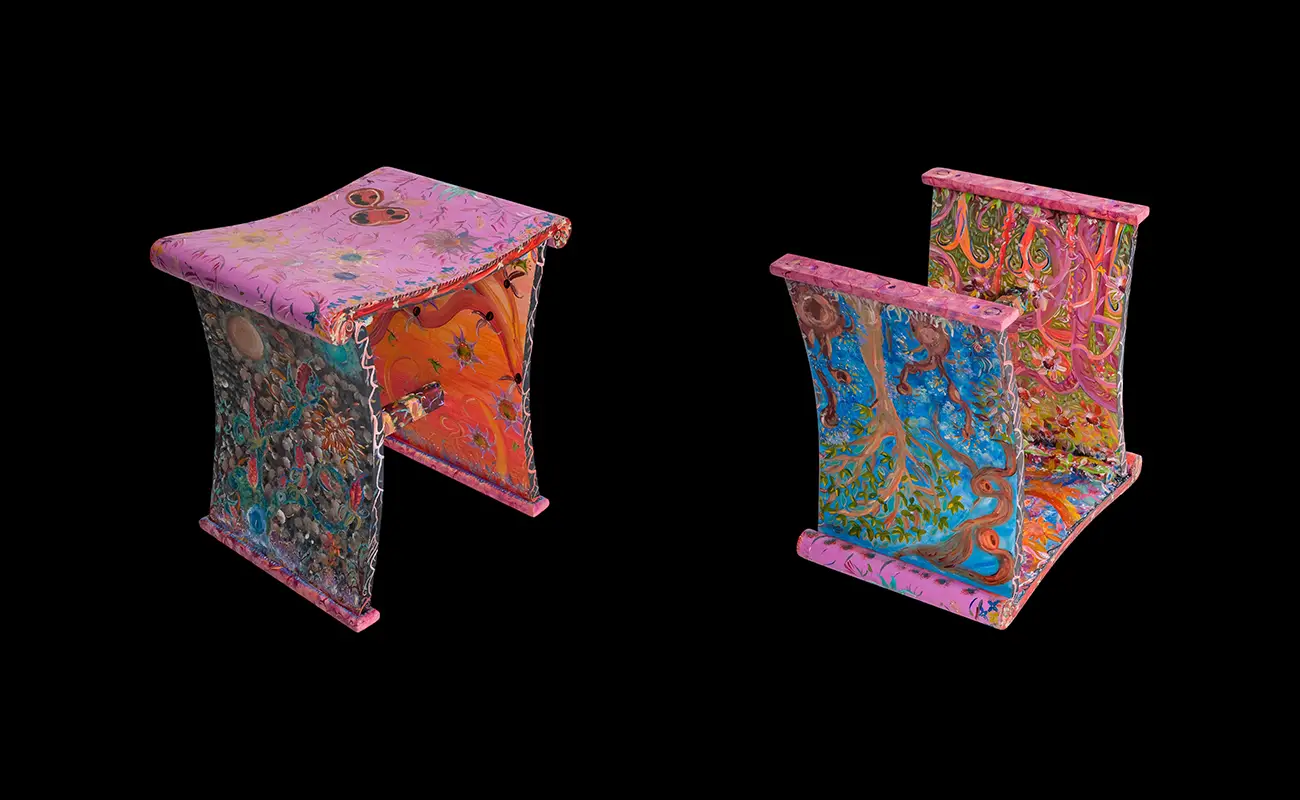
Through a natural convergence of her academic background, personal interests, and visual instincts, Snowden’s practice as a furniture artist took shape. Her creative voice found its medium in painting reclaimed furniture, where each piece became a visual journal layered with memory, intuition, and quiet rebellion. These objects are not merely restored, they are reborn—transformed into bold, functional narratives that mirror the intricacy of the ecosystems she once studied. What might appear as vibrant decoration to a casual viewer is, for Snowden, a language of forms, colours, textures, and creatures, celebrating life in all its mystery and interconnectedness.
Lyris Snowden: Storytelling in Paint and Timber
Snowden’s path into visual art was never rigidly planned. It emerged instead from a confluence of science, spontaneity, and circumstance. A lifelong drawer, she initially channeled her creativity into scientific diagrams and personal doodles—bright, intricate patterns that hinted at deeper instincts waiting to surface. As a collection of broken chairs began to accumulate, seemingly drawn to her from kerbsides and charity shops, their forms became a kind of invitation. When a friend encouraged her to transfer her drawings onto larger surfaces and a chalk paint workshop fell short of offering the complexity she craved, Snowden picked up acrylic paint and turned to the chairs. What followed was not just creative release, but transformation: the birth of her signature practice. Painting onto the surfaces of vintage chairs, she allowed her thoughts, poetry, and moods to pour out through line and colour. Each chair became an artifact of both personal and cosmic introspection.
Her stylistic identity is both distinctive and ever-evolving. Grounded in organic patterning and fluid storytelling, her work avoids rigid planning. Instead, it emerges through instinct and observation. Snowden frequently incorporates elements from the natural world—flowers, insects, fungi, moons, and galaxies—all of which carry layered meanings. Flowers appear as meditations on temporality and beauty. Moons illuminate paths both literal and metaphorical. Galaxies reflect our elemental origins as beings formed from stardust. Even the insects and fungi, often overlooked or dismissed, are rendered with a celebration of their uniqueness and ecological importance. Her approach makes room for all parts of a piece, even the undersides of furniture, to receive attention. These unseen surfaces often reveal hidden messages or “truth windows,” where untouched wood or an original maker’s mark is left visible, reminding viewers of the object’s origins.
Snowden’s work frequently incorporates her own poetry, written intuitively while she paints. These poetic additions are not decorative—they deepen the piece’s narrative and emotional scope. Her chairs become layered canvases where colour, line, and word merge into a singular expression. She resists compartmentalising her themes; instead, she allows the language of biology, spirituality, and introspection to coexist. Each piece is both a celebration of natural life and a reflection on human experience. Through her process, discarded objects become sacred vessels—bearing witness to the artist’s inner life and the grand, often mysterious life cycles of the planet.
Furniture as Canvas: The Practice of Purposeful Transformation
Snowden’s creative process is grounded in ritual and reflection. Her days often begin with the discovery of forgotten objects—vintage chairs or tables salvaged from the roadside or second-hand stores. These items, marked by age and neglect, require not only aesthetic attention but physical repair. Before any painting begins, she carefully strips the furniture down to its foundational form. This preparatory stage is a vital part of her process: it is here that she begins to see what each piece might become. Often, the chair or table will sit for days, even weeks, in her studio as she observes it and considers how the form can guide the story she wants to tell. There is no rush, only a slow accumulation of thought, observation, and inspiration.
Once the piece is ready, Snowden paints directly onto the wood using acrylics, building up complex visual narratives in layers. Her brushstrokes are guided by intuition rather than pre-determined sketches. Shapes and symbols often arise unbidden, emerging from a subconscious space fed by the natural world around her. The studio, with views of her lush garden, acts as both sanctuary and stimulus. Walks through her property between painting sessions sharpen her focus and replenish her well of imagery. Insects skittering across leaves, the texture of bark, the sudden appearance of a unusual fungus—all become potential motifs. Her paintings echo the organic rhythms of nature, interlacing flora, fauna, and fantasy with colour palettes that oscillate between the earthy and the otherworldly.
Among her most meaningful works is The Squid and the Moon (2025), a painted vintage timber chair that epitomises her vision. In this piece, a marine earthstar gives birth to celestial seeds while a giant squid carries them into the unknown. Though earthstars are terrestrial fungi found on her own land, they are reimagined here as ancient marine organisms. The squid, often associated with intelligence and mystery, becomes a cosmic courier. This chair explores themes of origin, transformation, and cosmic humility. It is a meditation on the idea that life springs from unimaginable beginnings, and that the universe remains largely beyond our grasp. More than just an art object, the chair functions as a philosophical prompt, encouraging viewers to reexamine what they think they know and to honour the unknown.
Lyris Snowden: Toward New Horizons of Art and Connection
The future of Snowden’s work lies not only in paint and furniture, but also in expanded forms of storytelling and engagement. Her upcoming projects continue her commitment to salvaging and transforming vintage furniture, with a focus on side tables and elaborate sideboards. These new pieces will offer larger surfaces and new challenges—more space for interwoven imagery, deeper layers of meaning, and even more intricate narratives. Each item of furniture represents a new opportunity for exploration, but the intention remains the same: to bring beauty, reverence, and imagination to objects once dismissed or forgotten. These projects are not simply decorative; they stand as quiet acts of rebellion against waste and disconnection.
Parallel to her studio work, Snowden is envisioning broader creative horizons. Her plans include travel outside Australia to immerse herself in other artistic communities, gain exposure to new environments, and further fuel her imagination. These journeys are not escapist; they are purposeful explorations designed to deepen her practice and broaden her understanding of how others engage with both art and nature. She seeks genuine connection—with place, with people, and with objects—believing that inspiration flourishes in diverse environments. Her travels will also serve as a springboard for future exhibitions, allowing her work to reach audiences beyond her immediate surroundings.
Perhaps most significantly, Snowden dreams of establishing her own gallery—more than just a venue for her painted chairs, it would be a space for community, collaboration, and conversation. In her vision, the gallery would serve as a creative hub where artists from various disciplines can gather, share, and create. It would reflect the same ethos that guides her art: a respect for life, an eye for beauty in the overlooked, and a commitment to transformation through care and imagination. Whether working in solitude in her studio or building bridges through exhibitions and travel, Snowden continues to follow the threads of observation, memory, and wonder—always attentive to what lies beneath the surface.
