
Unearthed Truths: The Origins of an Unflinching Artistic Voice
Kristine Kurbe’s creative voice was born in a time and place marked by scarcity, complexity, and quiet strength. Growing up in Soviet-era Latvia, she experienced a childhood defined not by possessions, but by the depth of human connection. This early exposure to emotional resilience and interpersonal authenticity became the compass that would later guide her uncompromising approach to art. Kurbe’s work refuses the gloss of comfort; instead, it ventures into the visceral territories of personal trauma and existential truth. What emerges from her hands are not softened portrayals of struggle, but bold revelations that explore the cost and necessity of transformation. Her canvases and mixed media constructions do not look away—they invite the viewer into a conversation with pain, memory, and survival.
This deep engagement with vulnerability is neither performative nor indulgent. Kurbe constructs her works from experiences that many might prefer to suppress. Instead of distilling them into abstract beauty, she confronts their intricacies. Her pieces hold within them the sharpness of trauma, the jagged edges of unresolved memories, and the flickering hope of understanding. By choosing not to edit out the discomfort, she challenges both herself and her audience to examine what often goes unseen. Her process functions as a reckoning, a mirror turned inward that then faces outward, reflecting the shared complexities of being human. The resulting works carry a haunting power, echoing with the ghosts of truths we fear to name.
Kurbe’s personal evolution has always paralleled her artistic growth. A foundational belief in honesty, shaped by early hardships, continues to define her method and message. Rather than pursuing perfection or superficial aesthetics, she aligns her efforts with emotional clarity. Each piece becomes a map of psychological terrain—intimate, often painful, but always urgent. This orientation toward artistic truth-telling positions her not just as a creator, but as a chronicler of internal battles and spiritual thresholds. Through her art, Kurbe gives form to what often remains formless: the silent, invisible struggles that shape our lives more than we dare admit.
Kristine Kurbe: A Gothic Sensibility Shaped by Beauty, Horror, and Ritual
Kurbe’s artistic style emerged from a richly layered convergence of influences that took hold early in her life. Encouraged by her mother to pursue art seriously, she embraced formal education in visual art and began sharpening her natural inclinations through structured training. Her teenage years were particularly formative, introducing her to the visceral world of tattoo art and the evocative creations of H.R. Giger. Giger’s signature blend of terror and elegance resonated deeply, validating Kurbe’s own desire to explore unsettling themes. At the same time, she was immersed in the study of Russian classical painting and literature, where she found a kindred exploration of darkness, psychology, and raw humanity. These dual influences—macabre expression and literary gravitas—became foundational to her voice as an artist.
Religious iconography also plays a central role in her work. Though Kurbe was raised within the Orthodox Christian tradition, she eventually grew into agnosticism. Yet the visual and symbolic elements of both Russian and Catholic religious practices remained deeply embedded in her imagination. The ornate rituals, sacred spaces, and intricate symbolism offered a visual lexicon through which she could articulate spiritual tension and moral ambiguity. These motifs persist in her practice, not as affirmations of belief, but as tools for dissecting faith, loss, and existential longing. Her visual language is therefore marked by a strong gothic aesthetic—infused with sacred references, anatomical elements, and the stark beauty of decay.
While tattooing once provided a meaningful outlet for Kurbe’s fascination with the body and permanence, her evolving need for conceptual exploration led her toward three-dimensional and mixed media work. These mediums offered the scale and complexity necessary to grapple with broader psychological and cultural questions. She now operates at the intersection of surrealism and the macabre, using skeletal forms and organic textures to confront themes of death, rebirth, and transformation. Her work is not designed to soothe—it is meant to stir, to unsettle, and ultimately to offer a passage through discomfort toward clarity. Kurbe’s style is unmistakable: elegant in its structure, unflinching in its message, and deeply rooted in the dark beauty of truth.
Opening Pandora: Memory, Inheritance, and the Weight of the Unspoken
Kurbe’s artistic practice is fueled primarily by her lived experience, shaped profoundly by the invisible burdens of generational trauma. She describes this inheritance as a kind of iron chain, each person a link weighed down by the unresolved pain of those who came before. Rather than shy away from this inheritance, she engages it head-on through her work. Each piece becomes a personal confrontation with memory—both her own and those passed down through family lines. Artmaking, in this context, becomes more than expression; it is a process of internal excavation. By confronting the darkness, she seeks not only to understand it, but also to transform it into something viewers can see, feel, and reflect upon.
This process resembles the mythic act of opening Pandora’s box: an exposure of what lies beneath the surface, knowing that once revealed, it cannot be hidden again. Kurbe approaches her work with this same sense of irreversible honesty. Each completed piece represents a journey through emotional excavation and psychological reassembly. The artworks serve as both the box and the contents—vessels that contain sorrow, grief, and buried truths, and yet also function as acts of healing. In revealing what is often concealed, Kurbe allows herself and her audience to acknowledge the wounds that never fully disappear but can still be understood. Her pieces are not meant to resolve pain, but to frame it in ways that allow recognition and resonance.
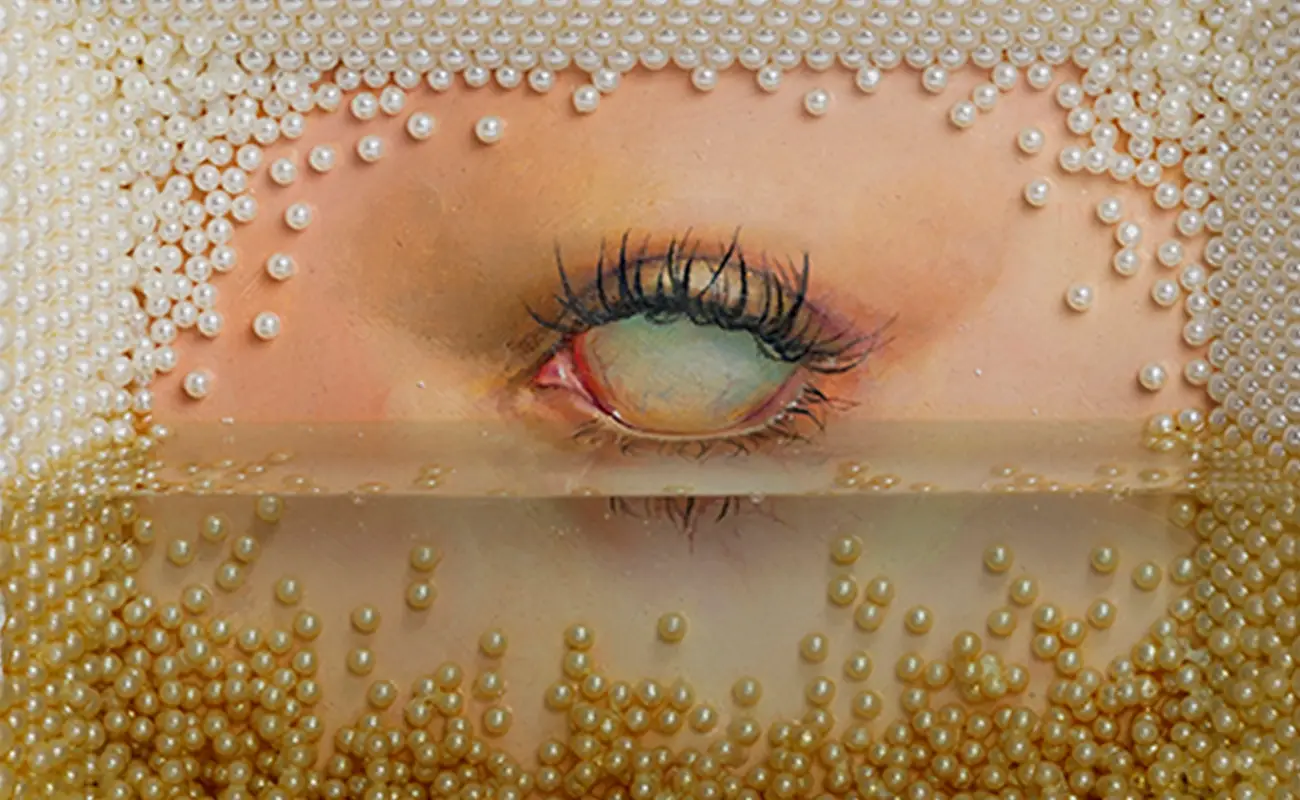
One of her most meaningful works, Secrets Weep (2025), embodies this paradox with poignant clarity. Using oil paint in pastel tones, faux pearls, and a crackle-textured vintage frame, Kurbe constructed a piece that radiates quiet elegance while brimming with unease. It addresses the invisible weight of unspoken secrets—the traumatic truths that the mind buries for self-preservation. The duality of wanting to be seen yet fearing exposure is at the core of the composition. Aesthetic beauty is used not as a distraction, but as a carrier of emotional complexity. The piece whispers rather than shouts, capturing the silent ache of inner struggle and the desperate yearning for authentic connection. Secrets Weep does not provide closure; instead, it lingers, much like the unresolved stories we carry within.
Kristine Kurbe: Constructing Shadows in Layers of Light and Bone
Kurbe’s day-to-day practice is rooted in a fluid, adaptable approach that mirrors the layered nature of her thematic content. Working predominantly in mixed media allows her to sustain multiple projects at various stages of development, creating a dynamic rhythm of experimentation and refinement. While one component dries or sets, she moves to another, maintaining a consistent momentum across her creative flow. This method reflects her philosophical orientation: transformation takes time, and no part of the process exists in isolation. Each layer—material or conceptual—builds upon the last, forming structures that are as emotionally intricate as they are technically complex.
Currently, Kurbe is immersed in the creation of her most ambitious piece to date, a large-scale work that demands a heightened level of precision and conceptual clarity. The project integrates several media, each chosen for its ability to carry different emotional and symbolic weights. Gothic themes pervade the piece, with skeletal imagery and religious symbolism anchoring the composition. These motifs recur throughout her portfolio, but here they are amplified in both size and intention. The technical demands of the project have pushed Kurbe to extend her skills, but she embraces the challenge as a necessary evolution in her practice. The work serves not only as a milestone, but also as a signal toward the deeper, more expansive investigations she is ready to pursue.
Looking ahead, Kurbe is committed to expanding this visual and thematic direction. Her focus remains on developing a body of work that continues to explore the intersection of sacred aesthetics, human mortality, and emotional transformation. She is particularly interested in how religious iconography can be repurposed to examine psychological wounds and existential fears. These forthcoming projects aim to deepen her dialogue with fear—not to resolve it, but to render it visible and speakable. In confronting the most shadowed corners of the psyche, Kristine Kurbe builds a space where discomfort becomes a necessary pathway toward authenticity, and where beauty does not deny suffering but is forged from within it.
